Terracotta Army Tickets in 2026: Prices, Passport Booking and How to Get There
Key Takeaways
- Admission is ¥120 for an adult and ¥60 for a student, and the museum charges the same price in peak and off-peak season. One ticket covers both the pits and Lishan Park, the archaeological site park where the emperor's tomb mound sits.
- Every visitor, foreign passports included, must book online in advance on a real-name system. The official channels are the museum website bmy.com.cn and the WeChat accounts "Qin Shi Huang Emperor's Mausoleum Site Museum" and "Terracotta Warriors Ticket Service Online".
- A passport is an accepted booking document, but the rules require the person, the ticket and the document to match. Bring the original passport you booked with; there is no ticket exchange at the gate.
- Gates open at 08:30. The last ticket check is 17:00 from 16 March to 15 November and 16:30 from 16 November to 15 March. The north gate is the only entrance and the route through the site runs one way.
- Free admission covers Chinese nationals only, so foreign visitors pay the full ¥120 at any age. Children of non-Chinese nationality under 1.4 m enter free, and the museum caps the site at 65,000 visitors a day.
- The cheap public route is Metro Line 9 to Huaqingchi, then the Lingtong 613 or 602 bus. The museum's own route notes put a public-transport trip from the airport at roughly two and a half hours.
Terracotta Army Tickets: Prices, Passport Booking and How to Get There
By Tony | China Travel Decider.
Quick answer: A Terracotta Army ticket costs ¥120 for adults and ¥60 for students, the same price in every season, and it covers both the pits and Lishan Park. Every visitor, foreigners included, has to book online in advance on the museum’s real-name system, using a passport as the document. The official channels are bmy.com.cn and the two official WeChat accounts. The site opens at 08:30; the last ticket check is 17:00 in peak season and 16:30 in off-peak season.
This guide contains affiliate links. If you book through them we may earn a commission, and that never changes the price you pay or what we recommend.
The Terracotta Army is the reason a lot of people put Xi’an on a China itinerary at all, and it is one of the few big sites in the country where the ticket system is genuinely tight. You cannot simply turn up, buy a paper ticket and walk in. The museum runs a real-name reservation system, it caps the site at 65,000 visitors a day, and it tells visitors outright to finish buying online before travelling out to Lintong district, about 40 km east of the city, to avoid traffic and queues.
That system trips up first-time foreign visitors in predictable ways. The booking site is built for a domestic audience. Free admission, which is real and generous, is written for Chinese nationals only. And the ticket turns out to include a second site, Lishan Park, that many guides barely mention.
What follows is what the museum’s own ticketing, visitor and transport pages publish, with the gaps flagged where the museum stays silent.
How much do Terracotta Army tickets cost?
A full adult ticket is ¥120 and a student ticket is ¥60, and the museum charges the same price in peak and off-peak season. That last point matters because plenty of older guides still describe seasonal pricing. The current price is published on the museum’s own ticketing page.
| Ticket | Price | Who it is for |
|---|---|---|
| Adult | ¥120 | Every adult visitor, including foreign nationals |
| Student | ¥60 | Full-time undergraduates and below at Chinese universities, with a valid student ID |
| Foreign child under 1.4 m | Free | Non-Chinese mainland nationality, accompanied by a parent |
| Chinese national, 65+ | Free | Chinese ID holders only, booked in advance |
| Chinese national, under 16 | Free | Accompanied by a guardian, Chinese ID holders only |
| Chinese national, disabled | Free | With a disability certificate, booked in advance |
| Electric cart, pits area | ¥5 | Optional, inside the first ticket gate |
| Electric cart, Lishan Park | ¥15 | Optional, inside the park gate |
Two things in that table are easy to misread.
First, the free-admission list is written for Chinese nationals. The museum’s wording attaches “Chinese nationality” to the over-65, under-16 and disability categories, so a foreign visitor over 65 pays the full ¥120. The concession written for non-Chinese visitors is free entry for children under 1.4 m, and that line appears on the museum’s ticketing page in both languages.
Second, the student half-price ticket is not an international student discount in the way travellers sometimes assume. It is written for full-time students at Chinese universities, and the museum’s wording excludes adult education, part-time and online courses. Take a student ID if you want to try it, but treat ¥120 as your planning number.
The electric carts are the only add-ons sold inside the site. The shuttle bus between the pits and Lishan Park is free, and there is nothing else to buy at the gate. If you would rather have a licensed guide and transport arranged together, Trip.com lists Terracotta Army day tours that bundle a guide and pickup , though you will still be checked into the same official ticket.
Do foreigners need to book Terracotta Army tickets in advance?
Yes, and the museum is explicit about it. Its ticketing page says the museum operates a real-name online reservation system and that all visitors, including Hong Kong, Macau and Taiwan residents, foreign visitors and people entitled to free admission, must reserve and pre-purchase through one of its official channels. Those channels are:
- The official website, bmy.com.cn.
- The official WeChat account “Qin Shi Huang Emperor’s Mausoleum Site Museum” (秦始皇帝陵博物院).
- The official WeChat account “Terracotta Warriors Ticket Service Online” (兵马俑票务在线).
The booking form accepts a second-generation Chinese ID card or a passport, so a foreign visitor books in the passport number. The website flow is built for a domestic audience, and both official WeChat accounts run bookings through the same real-name system.
A few rules come with the booking:
- One document, one ticket. The document you book with is the document you enter on. Families book each passport separately.
- The booker is the document holder. The museum states that the person, the ticket and the document must match before a ticket can be checked, which is why a name typed wrongly on the order is a real problem.
- Timed entry. Ticket inventory is split across time slots and the museum runs timed ticket checks. It asks visitors to be waiting about half an hour before their slot and to enter within it.
- Refunds before the check. A ticket can be cancelled before it is checked; once it has been used it cannot be refunded. Refunds go back to the original payment account within three to five working days.
- A daily ceiling. The museum publishes a maximum carrying capacity of 65,000 visitors a day and stops selling when it is reached.
On the booking window, be careful with the numbers you read online. The museum’s ticketing pages do not state how many days ahead reservations open. Third-party guides report seven days, and a guide published by Xi’an’s official city media a while back said eight days including the day of the visit. Both figures are second-hand, so the safe habit is to open the booking calendar early, see which dates are live, and book the moment your travel date appears. On holiday dates the daily ceiling is what decides whether tickets are still on sale at all.
One more point on tickets sold elsewhere. Travel platforms such as Trip.com and Fliggy list Terracotta Army tickets and tour bundles, and they can be convenient for payment and language. They resell the museum’s booking system; the entry rule that matters, a real-name ticket matched to your passport, is the same whichever route you buy through. Compare the total against the ¥120 face value before you decide.
What are the opening hours?
The site opens at 08:30 every day, and the day ends earlier or later depending on the season. The museum separates the two numbers that people confuse: the time ticket checking stops, and the time the gates actually close.
| Season | Gates open | Last ticket check | Site closes |
|---|---|---|---|
| Peak, 16 Mar – 15 Nov | 08:30 | 17:00 | 18:30 |
| Off-peak, 16 Nov – 15 Mar | 08:30 | 16:30 | 18:00 |
Two practical notes sit on top of that table. The museum states that times during major public holidays follow the latest announcement, so a Golden Week or Spring Festival date can run different hours. And the visitor guidance adds that both halves of the site, the pits and Lishan Park, stop checking tickets at the same time, so plan the second stop before you lose the afternoon to the first.
One inconsistency is worth knowing about. The museum’s English website still lists the season boundary as 1 March to 30 November, while the Chinese ticketing page uses 16 March and 16 November. The Chinese page is the more detailed and more recently maintained of the two, and the mismatch only affects visits in early March and mid-November. If your trip lands in that window, ring the ticket line, 029-81399127, and confirm.
What does one ticket actually cover?
The ¥120 ticket covers more than the three pits. The museum is two sites under one name: the Terracotta Army Museum, with Pits 1, 2 and 3, and the National Archaeological Site Park of the Mausoleum of the First Qin Emperor, usually called Lishan Park, where the emperor’s tomb mound and the bronze chariots are.
The museum’s own instructions spell out the deal:
- One ticket, both sites. The pits and Lishan Park share the same ticket. It is valid for the day of your visit.
- A free shuttle. When you leave the pits through the exit, you walk to the Terracotta Army coach park and take the free shuttle to Lishan Park. It is the museum’s own service.
- Three ticket checks. The single ticket is checked three times across the day. Lose track of the route and you can end up at a gate you have already used.
- About 1.5 hours each. The museum estimates roughly an hour and a half at the pits and the same again at Lishan Park.
This is the most common gap in third-party guides, and it has a real cost. A visitor who does not know Lishan Park is included often spends the whole morning at the pits, sees the one-way exit at lunchtime, and leaves without realising they paid for a second site down the road.
The route through the pits is one way, and the north gate is the only entrance. You go in at the north gate, move through the pits in order, and leave by the exit that leads to the shuttle. There is no going back through the gate you came in through. In practice that means the pits run one direction only, and it pays to decide before you enter whether you are doing Lishan Park the same day. If you are, leave enough time; if you are not, you have still paid for it.

How do you get to the Terracotta Army from Xi’an?
The museum sits in Lintong district, about 40 km east of central Xi’an, and the public route is a metro ride followed by a local bus. The museum’s own transport page sets out the options; the airport rows carry its published journey times, and for the rail stations allow about two hours.
| Starting point | Route | Journey time |
|---|---|---|
| Xi’an North railway station | Metro Line 2 to Beidajie, Line 1 to Fangzhicheng, Line 9 to Huaqingchi, then the Lingtong 613 or 602 bus | About two hours |
| Xi’an railway station | Metro Line 4 to Wulukou, Line 1 to Fangzhicheng, Line 9 to Huaqingchi, then the same buses | About two hours |
| Airport, public transport, via Huaqingchi | Airport bus and metro via Line 1 and Line 9 to Huaqingchi, then the Lingtong 613 or 602 bus | 2 h 30 m |
| Airport, all metro | Line 14 to Beikezhan, Line 4 to Xingzhengzhongxin, Line 2 to Beidajie, Line 1 to Fangzhicheng, Line 9 to Huaqingchi, then the bus | 2 h 47 m |
| Airport, metro plus direct coach | Line 14 to Shuangzhai, Line 3 to Tonghuamen, then the museum’s direct coach from the Qinfeng depot | 2 h 26 m |
The pattern is that everything funnels through Line 9, the suburban line running east towards Lintong. Get to Huaqingchi station, leave by exit C, walk about 200 m to the Huaqingchi bus stop, and take the Lingtong 613 (临潼游613) or the Lingtong 602 (临潼602) to the museum gate. The 613 and 602 are local buses, and they are the last, cheap leg.
There is a second Line 9 option worth knowing for when you want to skip Huaqingchi and its crowds: ride to Qinlingxi station instead, then take a local Lingtong bus from there. It is less direct but it keeps you off the main tourist corridor.
For the airport, the third row of the table is the one to aim for if you want the fastest public connection: Line 14 and Line 3, then the museum’s direct coach from the Qinfeng depot near Tonghuamen, at two hours 26 minutes. All three airport combinations land in the same broad window, so use two and a half hours as your planning figure.
A taxi or ride-hailing car from the city skips the metro-and-bus connection entirely, and the museum publishes no official fare. Quotes vary by app, by day and by traffic. If you take a car, agree the return leg before you leave, because the site is far enough out that finding a car at the gate at closing time is harder than finding one at your hotel.
You will also read about the old tourist bus 游5, also numbered 306, which runs from the Xi’an railway station towards the Terracotta Army. The route still exists, but the area around the railway station is where unauthorised drivers and touts work, and a person offering you “the 306” in the street is not the bus. Board official buses at their marked stops and pay on the bus.
For getting around once you are in the city, our guide to using Google Maps and ride-hailing apps in China covers what works on a foreign SIM, which matters when you are trying to navigate the Line 9 connection.
Do you need a guide at the Terracotta Army?
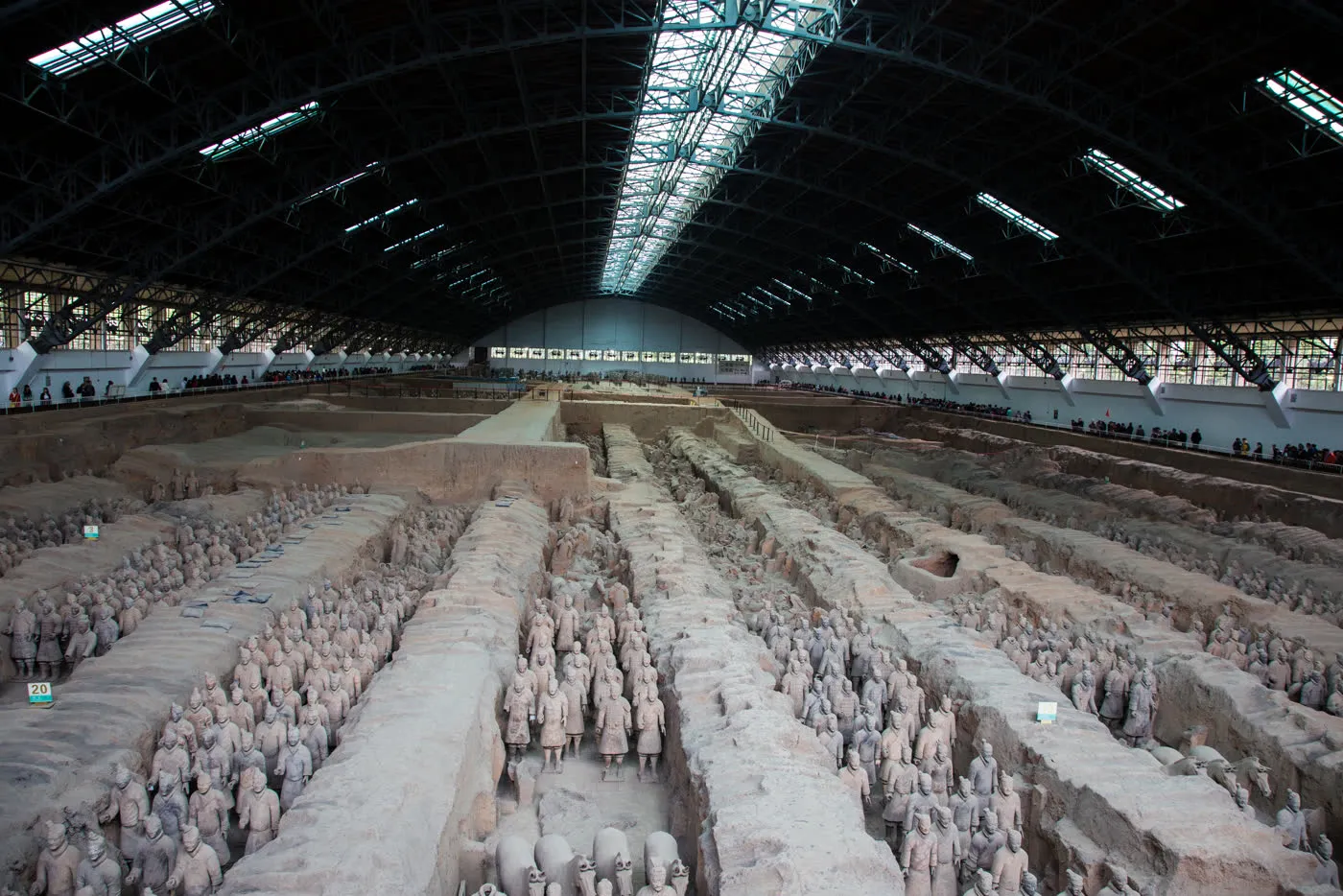
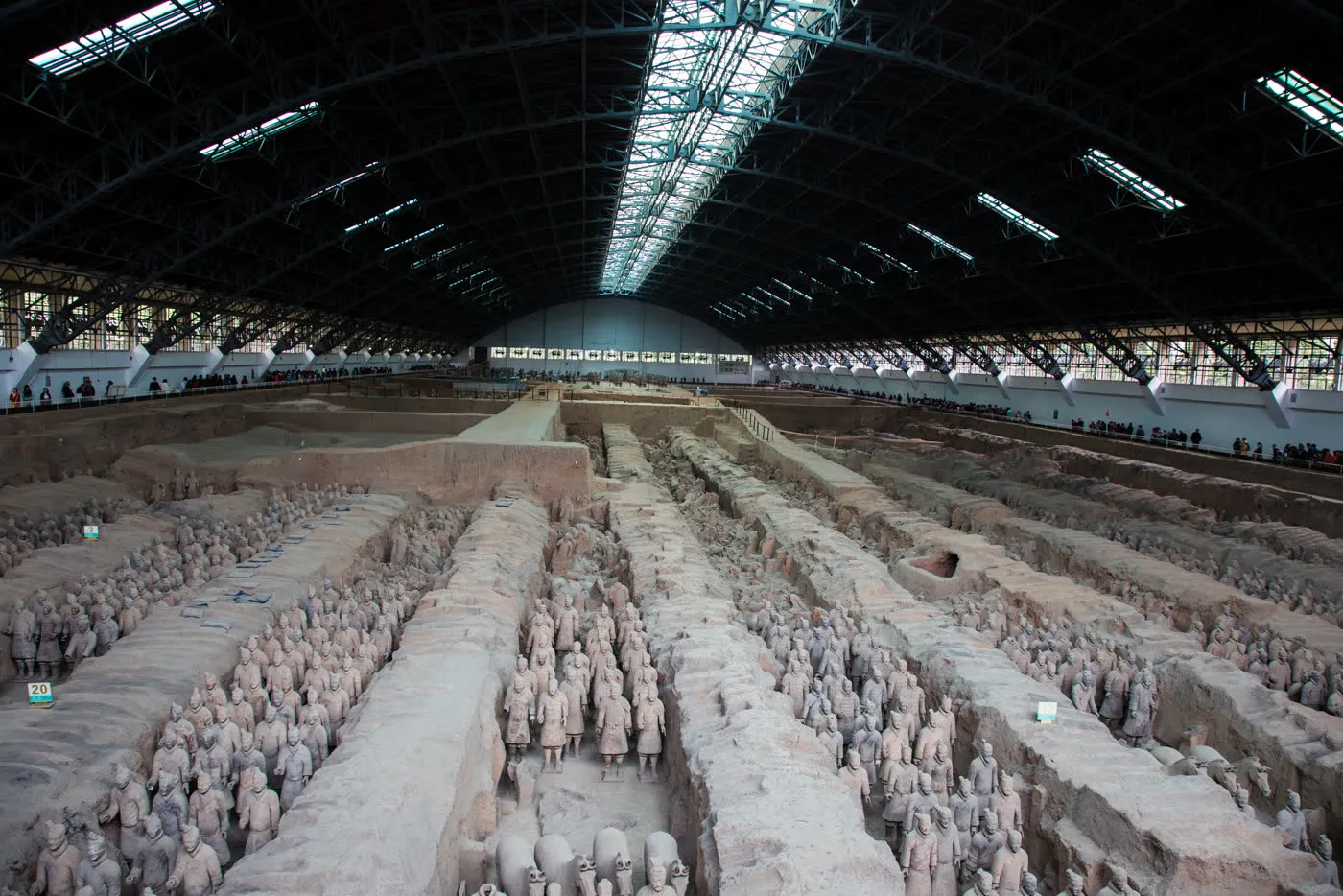
Not strictly, but the pits are the kind of site where context changes what you are looking at. Pit 1 is a roofed hangar the length of two football pitches, and without some explanation it is a very large room full of statues. The museum runs its own interpretation service and lists separate phone lines for it: 029-81399047 and 029-81399048.
There are three ways to handle it, and pricing is the weak spot in all of them.
- The museum’s own guide desk. Officially listed, reachable on the numbers above. The museum does not publish per-visitor or per-group rates for the guide service, so ask when you book or at the desk.
- A licensed guide booked with transport. Third-party operators sell day tours that pair a guide with a driver and pickup, which is the version many independent travellers choose. The guide fee is bundled into the tour price, so there is no separate ticket to buy.
- An audio guide. Most visitors end up with a recorded guide or an app. The hire price is not published on the museum’s website either, so confirm it at the rental desk.
The case for a guided visit here is straightforward: the site is a working archaeological one, and the difference between the three pits, the restoration workshops behind the scenes and the bronze chariots in Lishan Park is hard to read from the exhibits alone. If you decide to arrange a guide and pickup together, Trip.com's Terracotta Army tours include a licensed guide and a hotel pickup, which saves you the Line 9 connection on the way out.
The traps to know before you go
The Terracotta Army has a reputation among Chinese travellers as one of the most heavily touted sites in the country. The pattern is well documented, and knowing it in advance is most of the defence.
The replica “attraction” problem is real. Media reporting has described visitors being redirected from the real museum to replica sites a couple of kilometres away, venues that charge their own admission fees and sit inside commercial halls. The reporting documented a chain running from taxi and minibus drivers to freelance “guides” who earn a commission for delivering visitors to the wrong door. The replica venues operate as ordinary businesses; the problem is the pitch that presents them as the real thing, or as an extra part of it. The genuine museum is the Emperor Qinshihuang’s Mausoleum Site Museum in Lintong, with Pits 1, 2 and 3, and nothing else carries that name.
Anyone offering you a guide outside the gate is not the museum’s guide. The museum’s guided tours are arranged inside the site and on its published phone lines, not by people in coloured vests working the car park. Reporting has described freelance guides wearing museum-style uniforms and badges, and using lines like “the group you booked online won’t let you hear anything.” One repeated trick is asking you to cancel the ticket you already booked. Do not cancel a real-name booking for a stranger’s promises; that ticket is matched to your passport and it is your entry.
“High-tech” and VR add-ons are not part of the museum. A recurring report is visitors being sold an immersive experience that turns out to be a VR headset session in a street-side commercial building, sometimes after being told it is inside the site. The museum lists no such add-on. If an offer involves leaving the museum grounds, it is not the museum.
Bundled “ticket plus experience” packages can be a shopping route. Third-party packages that combine a guided tour, a tea break and a handicraft session are sold on domestic platforms, and reporting describes some of them leaving little free time and routing visitors through sales stops for jade, tea and souvenirs. Book a plain ticket, or a plain guided tour, and skip the add-ons you did not want.
Free admission is not for foreign passports. This is one of the museum’s own rules, and it catches people out. The over-65, under-16 and disability free tickets are written for Chinese nationals. Foreign visitors, whatever their age, pay ¥120.
You probably cannot buy at the gate on the day. The museum’s guidance tells visitors to finish booking online before setting out for Lintong, and the reservation system is real-name from the start. Turning up with no booking on a holiday date is a long trip for nothing.
Two practical rules hide in the security list: lighters, drones, kites, video equipment and skateboards or self-balancing scooters are on the banned-items list, so leave them at the hotel. The museum runs free luggage storage behind the ticket hall, but it will not take cash, documents, phones, computers, cameras, drones or other valuables, so plan to carry your passport and electronics with you.
The honest downsides
Most Terracotta Army guides stop at the ticket price. Here is what the same official pages make clear when you read them together.
The site is genuinely crowded at peak. The museum caps the site at 65,000 a day, and around Chinese public holidays that ceiling decides whether you get in at all. A timed-entry slot for a holiday week needs booking the moment your date appears on the calendar.
It is a long way out and the cheapest route is slow. The metro-plus-bus connection takes close to two hours each way in the museum’s own estimates, and the airport combinations run up to two hours 47 minutes. If you are on a short Xi’an stay, that is most of a day for one site. A car halves the friction at a cost that has no published rate.
The route is one way and the ticket is checked three times. You enter at the north gate only, move through the pits in one direction, and leave towards the shuttle. There is no wandering back. Add timed entry on top of that and a late arrival can mean a rushed pits visit and no realistic chance at Lishan Park.
Lishan Park is the part most people skip by accident. It is included in the ticket and it holds the tomb mound and the bronze chariots, but it needs a shuttle ride and another hour and a half. Visitors who do not know it is included often discover it too late.
The guide price is not published anywhere official. The museum lists phone numbers for its interpretation service but not a rate for it, and the same goes for the recorded guides. That is a budgeting gap you cannot close from a desk; ask when you book.
The booking window is not published either. Guides that quote seven days are reporting a third-party figure, and the number has shifted before. If your Xi’an dates are fixed early and you are travelling near a Chinese holiday, the missing information matters, because that is when the 65,000 ceiling binds.
The short version
Book a real-name ticket online through bmy.com.cn or an official WeChat account, using your passport, and pay ¥120. Aim for the 08:30 opening, be at the gate half an hour before your slot, enter at the north gate only, and leave time for Lishan Park, which your ticket already includes. Take Metro Line 9 to Huaqingchi and the Lingtong 613 or 602 bus if you want the cheap route, or arrange a car with the return leg agreed in advance if you would rather not spend four hours in transit. If you want the pits explained properly, sort out a guide before you arrive, because the gate-side offers are not the museum’s.
If you would rather have a licensed guide and hotel pickup handled for you, Trip.com sells Terracotta Army tours with a guide and transport included , and you still pay the standard admission on top. If you are doing it yourself, remember two things that cost people a day: you cannot normally buy at the gate, and free admission does not apply to foreign passports. For the wider trip, our China essentials guide covers visas and payments, and the Forbidden City booking guide walks through the same real-name reservation system for Beijing.
Frequently Asked Questions
Frequently Asked Questions
How much is a Terracotta Army ticket?
¥120 for a full adult ticket and ¥60 for a student ticket, the same price in every season. The ticket covers both the Terracotta Army pits and Lishan Park, the archaeological site park at the emperor's tomb, with a free shuttle between them. Children of non-Chinese nationality under 1.4 m enter free.
Can foreigners buy Terracotta Army tickets with a passport?
Yes. The museum's ticketing page lists the passport alongside the Chinese ID card, Hong Kong and Macau travel permits, Taiwan permits and the home-return permit as accepted documents. You book with the passport number, then show the original passport at the ticket check. The person, the ticket and the document must match.
Do you have to book Terracotta Army tickets in advance?
Yes. The museum runs a real-name online reservation system and states that all visitors, foreign visitors included, must book through its official website or one of its official WeChat accounts. There is a ticketing phone line, 029-81399127, but the published booking route is online.
How far in advance can you book Terracotta Army tickets?
The museum does not publish the booking window on its ticketing pages. Third-party guides report seven days, and an earlier guide from Xi'an's official city media said eight days including the day of the visit. Both figures are second-hand, so check the calendar on the booking site, which shows which dates are open.
Is Lishan Park included in a Terracotta Army ticket?
Yes. The museum is made up of the Terracotta Army Museum and the National Archaeological Site Park of the Mausoleum of the First Qin Emperor, usually called Lishan Park. They share one ticket, a free shuttle runs between them, and the ticket is valid for the day and checked three times.
How do you get to the Terracotta Army from Xi'an?
Take Metro Line 9 to Huaqingchi, then the Lingtong 613 or 602 bus, which stops near the museum. From Xi'an North or Xi'an railway station you first ride Line 2 or Line 4 to Beidajie or Wulukou, then Line 1 to Fangzhicheng, then Line 9. The trip runs close to two hours, and the museum is about 40 km east of the city centre.
You might also find useful

Zhangjiajie National Forest Park vs Tianmen Mountain: Two Different Parks
Zhangjiajie National Forest Park and Tianmen Mountain are two separate parks 40 km apart, with two separate tickets. The forest park costs ¥165 (¥236 with the shuttle) and Tianmen Mountain ¥285 for the current package. Here is which one to pick, what each costs, and how to get to both without a tour.

How to Buy Forbidden City Tickets as a Foreigner in 2026 (Passport Booking Guide)
Forbidden City tickets cost ¥60 (Apr–Oct) or ¥40 (Nov–Mar) and go on sale exactly 7 days ahead at 20:00 Beijing time. Here is how foreign visitors book with a passport, what happens when tickets sell out, and the refund rules most guides get wrong.

Beijing Attraction Reservations 2026: Which Sites Need Booking and How (Foreigner Guide)
Beijing attraction reservations: which sights still need booking, when tickets are released, the official channels, and whether a foreign passport is enough.